Federal Labor believes that there is now little doubt that the Coalition plans to increase the GST to 15 per cent with the recent leaking of Treasury documents.
The embarrassing leaking of Treasury documents exposes Malcolm Turnbull’s plans for a 15 per cent GST and gives the prime minister no choice but to come clean on his GST plans.
“We’ve always known that Malcolm Turnbull wasn’t being upfront with Australians about his plans for a 15 per cent GST, and now the proof is in,” said Labor’s shadow treasurer, Chris Bowen.
“Leaked Council of Australian Governments (COAG) documents expose Malcolm Turnbull’s plans for a 15 per cent GST on the price of everything.
“Reports show Treasury has been commissioned to model a whole range of GST scenarios,” Bowen said.
The options being considered at COAG include a plan to increase the GST to 15 per cent and to broaden the base.
“Liberals would go to any length to dud low and middle income households.”
“The documents also reveal a tricky and misleading Liberal government that is trying pull the wool over Australians’ eyes when it comes to any GST compensation,” Bowen said, “in which they state:
Public commitments around which households would be fully compensated should be avoided. Decisions about compensation will be more informed once the impacts of various options have been modelled. Making commitments now risks overcompensation for households and adding significantly to the cost of household assistance.
“The leaked documents demonstrate that the Liberal Party would go to any length to dud low and middle income households.
“For families already struggling to keep their heads above water, increasing the GST will push up the cost of living, make everything more expensive and leave families worse off.
“Stop hiding behind the ‘states made me do it alibi’.”
“Every time they have to pay a bill, visit a supermarket, take the kids to the doctor, buy new school books, it will all cost more.
“That’s why Labor will not support Mr Turnbull’s plan to raise the GST.
“Malcolm Turnbull and his treasurer need to stop hiding behind the ‘states made me do it alibi’; this is their plan to increase the GST,” the shadow treasurer added.
On the eve of a weekend of ‘peoples climate marches’ across the country, and in lead up to the Paris Conference on Climate Change, Opposition Leader Hon Bill Shorten, has committed Labor to a goal of a ‘net zero’ emissions target by 2050 – based on a baseline emissions reduction of 45 per cent by 2030.
Mr Shorten said Labor would use the Climate Change Authority’s 45 per cent reduction recommendation (on 2005 levels) as the basis for consultations with industry, employers, unions and the community.
“Because we know climate change is real, we all have an obligation to act,” Mr Shorten said.
“Malcolm Turnbull is flying to Paris carrying Tony Abbot’s climate-sceptic baggage and while he won the leadership vote in the party room, Tony Abbott has won the climate policy debate in the Liberal party.
“The Prime Minister will walk onto the aerobridge with a pathetic target in one hand and an expensive joke of a climate policy in the other,” the he said.
Labor’s stance on climate action comes as scientific evidence ‘irrefutably’ points to rising global temperatures with human activity as the cause.
“No area of scientific inquiry in the past 30 years has been more rigorously tested, scrutinised and peer-reviewed,” Mr Shorten said. “Let us not pretend that we have an obligation to give equal weight, coverage and credence to the babble of the denialist militia.
“Australia can benefit if we take action on climate change; we have a lot to lose if we don’t.
“Australia is much more than a small country, far away, without a voice in the great councils of the world.
‘We are a nation engaged with the opportunities of Asia, and a leader in the Pacific; a prosperous, stable and internationally-influential country.
“But of the more than 190 countries gathering for COP21, 55 will have bigger populations than ours, 11 will have larger economies, but we are the 13th largest polluter in the world, with the highest emissions per person in the OECD.
“And despite Liberal Government accounting chicanery, our domestic emissions are going up, not down,” Shorten said.
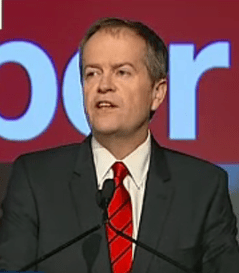
Hon Bill Shorten MP
As a backbencher, the prime minister labelled the government’s direct action policy as “an environmental fig leaf to cover a determination to do nothing”, telling the truth with nothing to lose.
“Yet now, when power is in his grasp and the evidence is in front of his eyes, he cannot admit what he knows in his heart and head to be true,” the Opposition leader said.
“This is actually far worse than scepticism; this is selling out the future of the people of Australia, to placate the right wing of the Liberal party.”
Australia needs stronger targets and a better policy and the first, long-term objective Labor is pledging itself to is for Australia to achieve net zero emissions by 2050.
“Stopping global warming means stopping new emissions,” Shorten said. “If we are to meet the global target of two degrees, we must reach a point at which we are not adding pollution into the atmosphere.
“This means by 2050, every tonne of pollution we produce will need to be balanced by sequestering, off-setting or purchasing.
“This is an ambitious goal, recognised by the Australian Climate Roundtable which includes groups as diverse as the Business Council of Australia, the Australian Conservation Foundation, the Australian Industry Group and the ACTU.
“Changing technology, modernising fuels and embracing clean energy does not mean trading-away our prosperity; it means the opposite.
“We can cut pollution and create jobs.
“Australia’s primary industries, including mining and agriculture will remain strong and important parts of our economy, while our energy sector will shift toward low-pollution sources through a process that will be handled sensibly, steadily and fairly.
“The Abbott-Turnbull 2030 target puts Australia at the back of the international pack because it falls well short of Australia’s obligation to help keep warming below two degrees on pre-industrial levels.
“Our target of a baseline emissions reduction of 45 per cent by 2030 on 2005 levels will work in concert with our net zero emissions 2050 objective, and this process begins today.
“Shadow minister for the environment and climate change Mark Butler will lead it, reporting to me and the shadow Cabinet by March next year.
“While a 45 per cent baseline reduction would be an ambitious target for Australia, particularly on a per capita basis, we should not shy away from ambition.
“Labor will also support a pledge and review process, every five years, to track our commitments and to respond to international action.
“As the business community, the Climate Change Authority and others have said, a combination of five year targets and long-term goals balances the need for flexibility and accountability, while also giving business the long-term signals they need to plan and invest.
“Within the first year of a Labor government, guided by our 2030 and 2050 goals, we will announce an emissions reduction target for 2025 and it will be a target shaped by the best available independent advice from policy experts, scientists and economists.
Mr Shorten’s commitment to an emissions target comes when thousands across Australia – including many ALP members – gathered to march for a transition to renewable energy, for secure job creation, for clean air, for a healthy environment and a safe climate.
 plans to increase the GST to 15 per cent with the recent leaking of Treasury documents.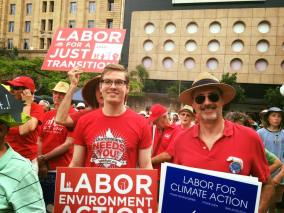
 Annerley Labor