Trust in Australian democracy has more than halved over the last decade, from 86% in 2007 to 41% in 2018. Part of this erosion of trust stems from a strong belief that big business has too much power.
Community concerns have sparked calls for a federal anti-corruption body and political donations reform. People are concerned that politicians are privileging the concerns of their allies in big business over the community or the public good.
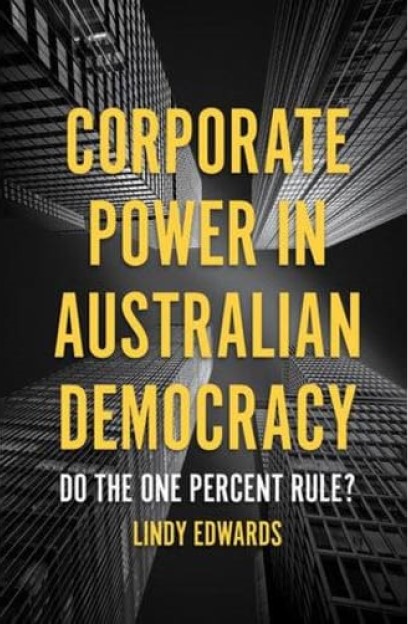
In her latest book, Corporate Power in Australia – Do the 1% Rule?, Dr Lindy Edwards discusses the evidence for these public fears, looking at mining companies and the mining tax; the banks and the financial advice scandals; Telstra and the NBN; News Ltd and media reform; Coles and Woolies versus the farmers; and attempts by government to reform contract laws and laws on the abuse of market power. Importantly, her book explores if the major corporates are disproportionately winning in our political debates? And if so, why?
Although Federal Labor, and more broadly, the union movement, took the ‘corporate power’ narrative to the 2019 election, there have been other voices echoing the sentiment of too much corporate control. For example, Allan Fels, the Howard-era head of the Australian Competition and Consumer Commission (ACCC), has also argued that the policy process is being ‘captured by vested interests like never before’.
Dr Edwards agrees with the now well documented assessment that economic power has become much more concentrated over the last 30 years. For example, the ACCC reports that the ASX top 100 companies’ share of GDP has increased from 27% in 1993 to 47% in 2015. Even amongst the top 100 companies, wealth is heavily concentrated at the top. Wesfarmers income was almost $67 billion in 2018, while few companies outside the top 20 made it over the $10 billion threshold.
In addition to the growing concentration of economic power, Dr Edwards also notes that corporations have also ‘professionalised’ their approach to political lobbying, which has now become a recognised career with an estimated 5,000 professional lobbyists operating in Canberra.
As mentioned, Dr Edwards explores a number of policy clashes that clearly demonstrate the over-reach of corporate Australia. She claims that in most cases each business sector is controlled by between one and four big companies that dominate supply chains made up of tens of thousands of people. These corporations are focused on redistributing wealth along their supply chains and into their own hands. In each of her case studies, the corporations were battling with government over laws that shape where profits sit in the supply chain. Indeed, she describes the struggle over these types of laws as one of ‘the most critical battles of the modern age’. In fact, the wealth of the 1% has grown disproportionately over the last 30 years due to the powerful scraping of wealth out of chains in this way.
Following on from the discussion of her case studies that back her claim of disproportionate corporate power in the political process, it is not surprising that one of her key solutions is political donation reform. There has been a growing call for corporate money to be removed from the political process, even before Clive Palmer spent $60m on the 2019 federal election. If anything, the 2019 result underscored the need to urgently reform how our elections are funded and how our political parties access and spend those funds.
If anything, this book is a timely reminder that our democracy has become more of an auction thats eschews transparency and balanced political discourse. A citizenry concerned about the state of its democracy and the way decisions are made need to be armed with the arguments presented in this book and demand change from our elected representatives.
Dr Lindy Edwards’ Corporate Power in Australia: Do The 1% Rule? is available from Monash University Press.
Dr Edwards is a political scientist at the University of New South Wales. She is also the author of How to Argue with an Economist: Re-opening Political Debate in Australia from Cambridge Uni Press.

 Annerley Labor